
Neural Pathway Massage (NPM)
Neural Pathway Massage (Hermoratahieronta) is a Finnish treatment method delivered fully clothed, using precise fingertip techniques and specialist neural maps rather than heavy pressure. It is designed to support how the nervous system communicates with the rest of the body, which is why many clients choose it when they feel stuck in repeating symptom cycles.
In Finland, the method is closely associated with the long development work of Annikki Kankkunen, who began this work in the 1960s and helped formalise practitioner training from the 1980s onward.
Today, clients often seek NPM for persistent pain, migraine patterns, stress overload, sleep disruption, hormonal symptom patterns, jaw and neck tension, digestive discomfort, and ongoing fatigue when other approaches have not given enough change.
Key Facts About NPM
• Session length: Up to 120 minutes
• Treatment style: Gentle, precise neural-map based work
• Oil use: No oil
• Clothing: Fully clothed, no undressing needed
• Pressure level: Very light to light
• Positions used: Both face up and face down
• Best for: Recurring symptom cycles, nervous system overload, and chronic pain and tension patterns
• Suitable for: All ages
• Format: Most effective as a structured treatment series

What NPM Is
Neural Pathway Massage is one of Finland’s most distinctive treatment methods and is still exceptionally rare in the UK. Some clients describe it as “acupuncture without needles” because the work is precise and point-based, but done with gentle fingertip techniques rather than needles or heavy pressure.
What makes NPM different is its map-based approach and its focus on the nervous system, the body’s control network. Muscles respond to nervous system signalling, so when that signalling is overloaded, tension and symptoms can keep returning even after strong hands-on work. NPM uses targeted neural maps selected for your symptom picture, making each session specific to you rather than generic.
Many people choose NPM after feeling stuck in repeat symptom cycles and short-term relief patterns. In a structured treatment series, clients often report meaningful improvements in comfort, sleep, recovery, day-to-day function, and overall quality of life.
Who This Is Best For
NPM is a strong option for people who feel they are doing all the right things but still not getting lasting progress. It is often chosen by clients who have tried multiple approaches and want something gentler, more precise, and better matched to how their body is currently responding.
It is well suited to busy professionals, parents, active clients, and older adults who need effective support without heavy pressure. Because the treatment is fully clothed and very light in touch, it is also a good fit for people who find deep tissue work too intense or draining.
NPM is especially valuable for those who want a structured, personalised process that can be adjusted over time as their system settles and function improves.
What It Can Support
NPM is commonly chosen for persistent or recurring patterns such as chronic pain, stress-related overload, low mood, migraines and headaches, sleep disruption, fatigue, jaw and neck tension, digestive discomfort, and hormonal symptom patterns.
It is also used when nervous system overload starts to affect everyday life, such as poor recovery, fluctuating energy, reduced resilience, concentration difficulties, or a constant “wired” feeling in the body.
During treatment series, clients living with longer-term conditions, including arthritis, MS, Parkinson’s, dementia, epilepsy, ADHD, and psoriasis, have also reported meaningful improvements in comfort, day-to-day function, and quality of life. NPM is not presented as a cure or disease-modifying treatment. It is a targeted supportive therapy designed to help people function better, feel more regulated, and maintain quality of life as well as possible over time.
Common Reasons People Choose NPM
Common Reasons People Choose NPM
Everyday Pain and Tension
Back pain and flare-ups
Neck and shoulder tension
One-sided tightness patterns
“Always tight” muscle patterns
Widespread aches and stiffness
Old injury compensation
Movement and Joint Restriction
Joint stiffness and reduced mobility
SI joint irritation patterns
Hip and pelvic discomfort
Frozen shoulder-type restriction
Disc bulge-type patterns
Training and overuse load
Nerve Pain and Radiating Symptoms
Sciatica-type symptoms
Tennis or golfer’s elbow
Numbness and nerve irritation
Pins and needles patterns
Arm and hand pain patterns
Leg and foot pain patterns
Plantar fasciitis and heel pain
Restless legs syndrome (RLS)
Head, Jaw, Face, and Ear
Migraines and recurrent headaches
Tension headaches
Jaw tension and TMJ-related tightness
Facial pressure and sensitivity
Sinus congestion-type discomfort
Ear pressure and “blocked” ears
Dizziness and balance patterns
Vertigo-type symptoms
Tinnitus support context
Dry mouth or excess saliva
Respiratory, Skin, and Immune-Related Symptom Burden
Breathing-related discomfort patterns
Asthma/allergy-related symptom burden (supportive context)
Eczema, rash, and other stress-reactive skin symptom patterns
Autoimmune-related day-to-day symptom load
Long-Term Conditions & Complex Health Support
Multiple sclerosis (MS) support for day-to-day symptoms
Parkinson’s support for movement, stiffness, and comfort
Epilepsy support (alongside medical care)
Dementia support for comfort and routine
Diabetes-related nerve and circulation discomfort
Stroke or paralysis support (alongside rehab and medical care)
Stress, Sleep, Mood, and Nervous System
Chronic stress and overwhelm
Burnout and low resilience
Feeling constantly “switched on”
Trouble winding down
Poor sleep and broken sleep (insomnia)
Waking unrefreshed
Stress-related fatigue
Anxiety and panic-type symptoms
Depression-related symptoms
Mood swings and emotional volatility
Brain fog and mental tiredness
ADHD-type attention strain
Restless body and agitation
Sensory sensitivity and overstimulation
Digestion, Metabolism and Fluid Balance
Bloating and abdominal discomfort
IBS-type symptom patterns
Constipation patterns
Reflux-type discomfort patterns
Sluggish digestion patterns
Absorption concerns (supportive)
Hormonal and Body Regulation
PMS and cycle-related patterns
Menstrual discomfort patterns
Menopause-related symptom load
Thyroid-related symptom patterns
Urinary frequency-type concerns
Breast discomfort patterns
Prostate symptom burden (supportive)
Fertility support (complementary)
Circulation, Swelling, and Heaviness
High or low blood pressure
Heavy legs and sluggishness
Fluid retention and puffiness
Swelling-type patterns (non-acute)
Circulation-related discomfort
Skin, Allergy, and Flare-ups
Stress-reactive skin flare-ups
Eczema, psoriasis, and rash patterns
Asthma or allergy symptom load
Breathing discomfort patterns
Immune-type flare-up patterns
“Hard-to-place” symptom pictures
Unexplained recurring symptoms
Symptoms that keep moving
Mixed symptom combinations
When local treatment is not enough
When medication feels limited
What a Session Feels Like
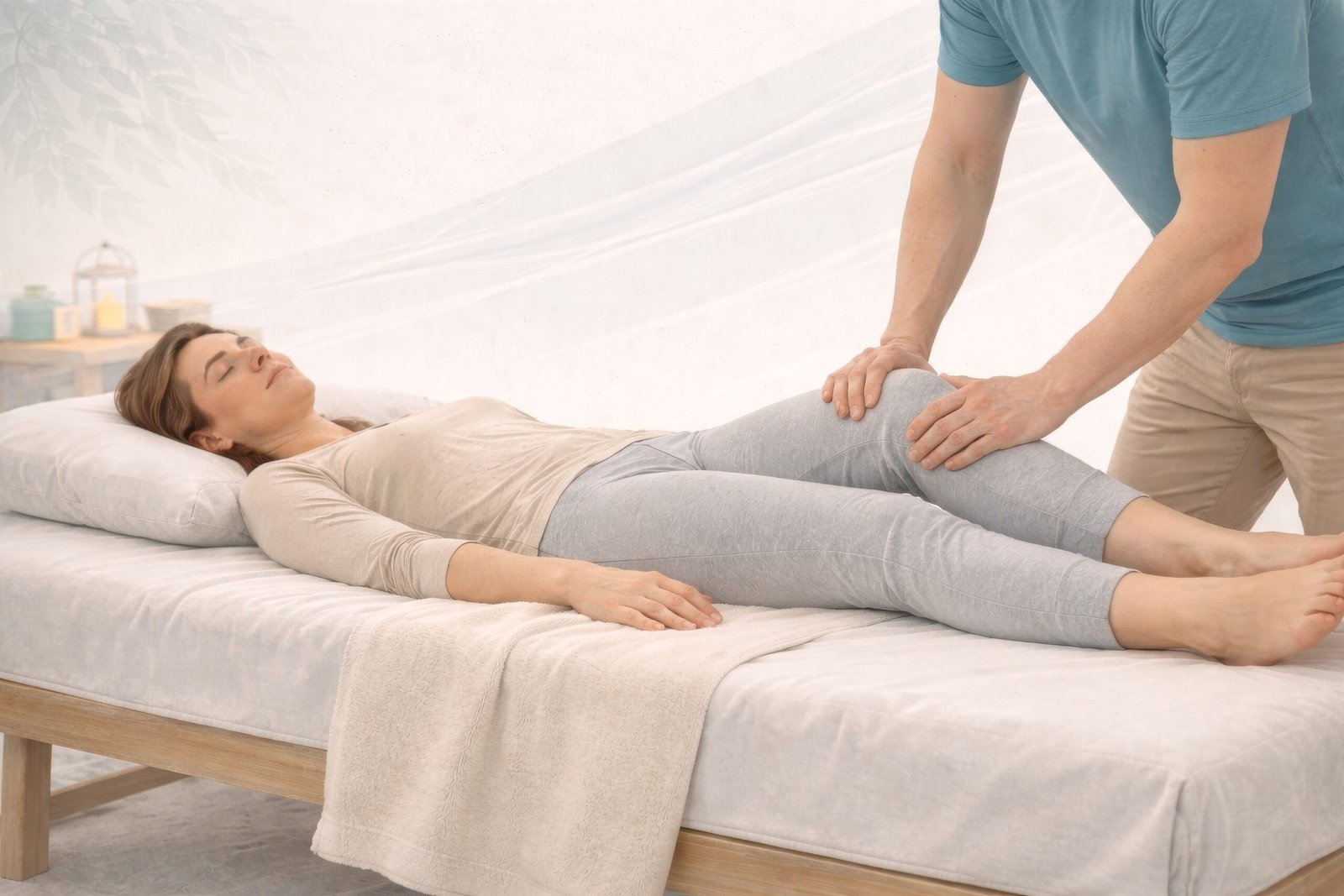
Your session starts with a short consultation so we can map your current symptoms, history, and goals. Treatment is then delivered fully clothed, using light fingertip pressure and precise circular techniques across selected neural pathways.
Most clients experience the session as deeply calming, often closer to a nervous-system reset than a traditional massage. Many feel their body settling during treatment, and some drift into a very restful state.
After the session, people commonly report better sleep, clearer thinking, and a lighter, more regulated feeling in the body. If your system has been under long-term stress, you may also feel temporarily tired or emotionally sensitive for a short period as the body adjusts. This usually settles within 24 to 48 hours and is reviewed as part of your treatment planning.
Good Things to Know About NPM
NPM is usually most effective as a treatment series, not a one-off session. A practical minimum is often three sessions, with five or more commonly recommended for longer-standing or more complex patterns. Early sessions are often about helping the body feel safe with the treatment and reducing defensive overload. From around the third session onward, it is usually possible to work more progressively and apply more advanced map choices based on how your system is responding.
It helps to think of NPM like training the body back into better regulation over time. One session can be useful, but lasting change normally needs consistency, especially when symptoms have been present for months or years. Clients who follow a structured plan often report meaningful improvements in pain patterns, stress tolerance, sleep, digestion, hormonal symptom patterns, and overall day-to-day balance. Progress varies by person, but steady, tailored work is what tends to deliver the strongest results.
A Monthly Reset for Busy Professionals
When your workload is high and your schedule never really slows down, your nervous system can stay in overdrive long after the workday ends. That often shows up as poor sleep, mental fatigue, irritability, shallow recovery, and a constant “always on” state. NPM is especially well suited to this because it is gentle, precise, and designed to help the system shift out of chronic overload.
For many busy clients, the session itself is part of the value. It is protected time to fully switch off, reset, and recover without demands, notifications, or pressure. Many men in high-stress roles say this dedicated space to decompress has had a meaningful impact on their wellbeing, home life, and ability to handle daily pressure more steadily.
Across treatment series, clients in high-responsibility roles, including senior office professionals and clinicians, often report major improvements in sleep and overall recovery. Some have said they had forgotten what proper rest felt like before starting NPM. If your role depends on sustained focus and decision-making, NPM is well worth trying. Many clients who once relied on regular deep tissue now choose NPM for broader, whole-system support and more consistent day-to-day performance.
Safety and Contraindications
NPM is a gentle, low-pressure treatment that can be adapted for different ages, including children from around age five, depending on individual suitability. There is no fixed upper age limit.
There are a small number of important contraindications. NPM is not provided during pregnancy as a general rule. In late-term pregnancy, once the baby is due and labour has not started naturally, specific NPM mapping can be considered to support the onset of labour in an appropriate and carefully assessed setting.
If you have had recent surgery or an invasive procedure, a recovery period is required before treatment. A typical guide is around two to three months, depending on the type of operation, the area treated, and how recovery is progressing.
If you have cancer, or you are under current or recent oncology care, medical approval from your doctor is required before starting NPM.
If any of these apply, please contact me before booking so I can guide you safely on suitability and timing.
Session Length
Session Length
For NPM to be effective, sessions need to last at least 90 minutes. Most appointments are planned as up to 120 minutes, with the treatment portion typically averaging around 1 hour 45 minutes and the remaining time used for consultation, progress review, and planning your session on the day.
Follow-up treatments usually fall between 90 and 120 minutes. The exact hands-on time can vary because different neural maps take different amounts of time to apply. Some symptom patterns can be treated with shorter map sequences, while more complex presentations require longer, more detailed mapping work.
This is why a fixed duration is not always realistic in NPM. One session may finish closer to 90 minutes, while the next may be near 120 minutes, depending on what your body needs and which maps are prioritised that day.

Session Length
Client Stories
“I booked in because I wanted to bring my body back into balance. I’d been dealing with painful sciatica that was affecting everything, especially sleep and day-to-day movement. After the first session I felt a real shift. I could move more freely, and I slept better that night. It honestly felt like I’d left years behind in the treatment room.
I’ve now been doing a treatment series, and after each session I’ve felt more relaxed and more connected to my body and mind. I’d recommend Neural Pathway Massage to anyone who wants to stay mobile, sleep better, and feel like themselves again.”
-Ulla-Maija-
——————————————
“I have known Jani for a few years now and was recommended to me by my flatmate.
I experienced chronic migraines, muscle tension, nervous system issues caused by mental health, amongst other issues. I was also unable to sleep or was waking in the night.
Jani was able to provide a very holistic approach and tailor to my needs by what issues I was having. The treatment I received was nothing like before where I was use to having sports/deep tissue massages.
Over time I was able to sleep better, reduce my anxiety levels as well as migraines. But this was not a quick fix which is why I needed to go every couple of weeks for two hour sessions.
I would recommend anyone who is experiencing migraines, anything stress related which inevitably this affects your entire body without realising it.
I definitely would recommend, Jani is professional and understanding by using his knowledge and history of your needs and concerns. He is able to tailor to each concern and sometimes combining treatments altogether.”
-Sarah-
NPM F.A.Q
NPM F.A.Q
Neural Pathway Massage is a Finnish therapy method that works through the nervous system using gentle, precise fingertip techniques and targeted neural maps. Instead of focusing on muscle pressure alone, it aims to support how the body regulates pain, stress, recovery, sleep, and other day-to-day functions.
Traditional massage often focuses on local muscle tension. NPM takes a wider systems-based approach and works through neural pathways linked to different symptom patterns. Many clients describe it as “acupuncture without needles” because of the precision and map-based approach, but it is a manual therapy with touch, not needling.
Yes. NPM is carried out fully clothed and no oil is used. Please wear light, comfortable clothing so treatment points can be accessed accurately and you can relax fully. Thin layers work best, as thicker fabrics can reduce precision and make the treatment less effective.
Most people experience NPM as very gentle and deeply calming. Pressure is light, and many clients feel their system settle during the session. Some even fall asleep. After treatment, people often report better sleep, calmer energy, and clearer thinking.
Effective NPM sessions usually need at least 90 minutes. Most sessions are carried out within a 90-120 minute window, with average hands-on time around 1 hour 45 minutes and the remaining time used for consultation and treatment planning.
Different neural maps take different amounts of time. Some symptom patterns involve simpler map combinations, while others require more detailed sequencing. That is why one session may be closer to 90 minutes and another nearer 120 minutes.
NPM is usually most effective as a series rather than a one-off. A practical minimum is 3 sessions, while 5 or more is often recommended for longer-standing or more complex patterns.
For most people, the best start is to schedule the first sessions around 1-2 weeks apart so the nervous system can settle and build momentum. After that, spacing is adjusted to your response, commonly every 2-4 weeks.
For maintenance, intervals vary by person. Some clients come every 2-6 weeks, some every few months, and some only a few times per year. The right rhythm depends on your goals, stress load, symptom history, and how your body responds over time.
Clients commonly seek NPM support for recurring symptom patterns such as chronic pain, migraines, sleep disruption, fatigue, stress overload, jaw and neck tension, digestive discomfort, hormonal symptom patterns, and nervous system dysregulation. It is also often chosen when people feel they have tried many options without enough lasting change.
NPM is not presented as a cure, but many clients living with longer-term conditions use it as supportive care to improve comfort, function, and quality of life. Where relevant, treatment is adapted carefully and progressed in a structured way.
NPM can be adapted for a wide age range, including children in appropriate cases, and there is no fixed upper age limit. Suitability is always assessed individually based on current health status.
Yes, many active clients use NPM as part of their performance and recovery strategy. Treatment series can support better recovery quality, movement efficiency, and nervous system regulation under training load. Clients preparing for events, including endurance races and competitions, often report feeling more balanced, less overloaded, and better able to perform consistently. As with any therapy, results build with consistency rather than one session alone.
NPM is commonly chosen by people under sustained stress load, including burnout and low mood patterns. Clients often report better sleep, calmer baseline energy, and improved resilience in day-to-day life. It is supportive care, not a replacement for mental health or medical treatment, but it can be a valuable part of a wider wellbeing plan.
Yes. NPM is not provided during pregnancy as a general rule. If you have had recent surgery or an invasive procedure, a recovery period is usually needed before treatment, commonly around 2-3 months depending on the procedure and recovery progress. If you have cancer or are under current or recent oncology care, doctor approval is required before treatment.
In late-term pregnancy, when the baby is due and labour has not started naturally, specific mapping may be considered in appropriate circumstances.
Some clients feel immediate calm and clarity. Others may feel temporarily tired, emotional, or slightly achy for 24-48 hours as the body adjusts. This is usually short-lived and is reviewed as part of ongoing treatment planning.
Yes. NPM can be booked as a standalone therapy or integrated into a broader treatment plan, depending on your goals and symptom picture.
No. NPM is a complementary manual therapy and does not replace medical diagnosis or essential medical treatment. If you have severe, unexplained, or worsening symptoms, medical assessment should come first.
In many cases, yes. Because NPM is gentle and regulation-focused, some clients with ADHD find it helpful for restlessness, sleep quality, and general nervous system settling. Treatment is adapted to the individual, session pace can be adjusted, and consistency usually matters more than intensity.
NPM may be used as supportive care for people living with Parkinson’s or MS, with treatment adapted carefully to current function and fatigue levels. In a structured treatment series, many clients and families report meaningful improvements in day-to-day comfort, mobility confidence, recovery, and overall quality of life. NPM is not presented as a cure, and it does not replace medical care, but it can be a valuable complementary therapy that helps people maintain function and daily stability for longer.
NPM starts with the nervous system, because that is the system that runs everything else. Your muscles only do what the nervous system tells them to do. If that signalling is overloaded from stress, poor recovery, old injuries, or constant pressure, tightness and pain can keep coming back no matter how many deep tissue sessions you have.
That is why NPM is gentle but highly targeted. It is not about using more force. It is about improving communication between brain and body so the system can regulate properly again. When that happens, muscles often begin to release without being forced.
Many clients who were unsure at first are surprised by how strong the effect feels. Even with light touch, they often report better sleep, calmer energy, and a body that feels looser, steadier, and easier to live in.